
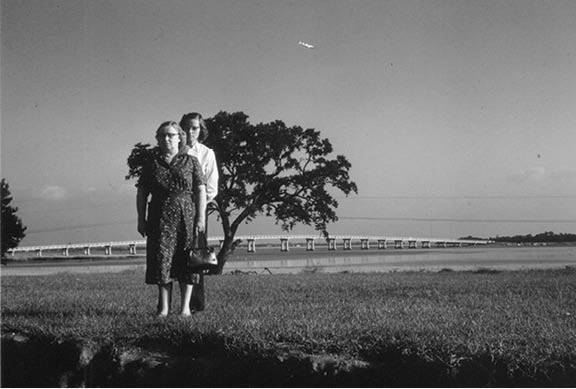
For centuries, crossing the Ashley River has shaped the communities on both shores
 On October 5, 1955, the creosote tanker “Fort Fetterman” struck the Ashley River Memorial Bridge, destroying the western draw span. Folks living in St. Andrew’s Parish had become quite accustomed to the convenience of this bridge with its electrically operated double lead Strauss bascule main span. In the quick moment of a navigation miscalculation, the easy trip to the peninsula of Charleston, Mt. Pleasant, and the Naval Shipyard had become a logistical nightmare.
Once again, the residents of St. Andrew’s Parish were isolated by water.
Rivers, creeks, and marshes define the Lowcountry and have contributed to the course of the area’s history. The first settlers sailed up the Ashley River until they found an appealing creek, set anchor, and stepped off the boat onto a rich and beautiful land that would soon be known as St Andrew’s Parish. This was 1670. It was not long before there were commissioners responsible for laying out and digging waterways, establishing ferries, and building bridges.
In 1808, the Charleston Bridge Company was granted a charter to build a bridge (New Bridge #1) across the Ashley River. New Bridge #1 was destroyed by a hurricane, and it was back to a ferry system until New Bridge #2 was constructed in 1854. This bridge operated successfully until the Civil War, when Colonel Bull decided to burn it rather than allow General Sherman to reach Charleston proper.
 By the late 1880s it was necessary to once again think about crossing this river. Farming and the expansion of phosphate mining were creating an economic recovery of sorts for the Parish. Transportation of goods to market needed to be improved. New Bridge #3 was constructed in 1886. In 1889 a small pamphlet entitled: A Little History of St Andrew’s Parish and its adaptability to early truck farming, dairy farming, stock raising, and other purposes was published by the Charleston Bridge Company.
The company had been successful in receiving a charter and had built yet another “New” Bridge across the Ashley River. In the pamphlet, it stated: “The completion by the Charleston Bridge Company of the bridge across the Ashley River connecting St. Andrew’s Parish with the City of Charleston has reopened and again placed in easy communication with the city, a very valuable section of country specially adapted to early market gardening.”
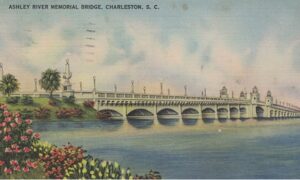
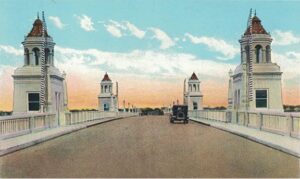 The bridge served the area with low toll rates: 5 cents for walkers, 10 cents for horse-drawn vehicles, and 15 cents for autos until it was damaged by a storm in 1893. By 1894, the replacement, New Bridge #4, spanned the river. In 1921, the County purchased the bridge and lifted the tolls. Transportation was rapidly moving to automobiles, and this bridge of wood and iron was becoming obsolete. In 1926, New Bridge #4 was torn down and replaced with the Ashley River Memorial Bridge (New Bridge #5).
When the collision occurred in October of 1955, the good news was that construction was in progress on a second Ashley River Bridge (New Bridge #6), known formerly as the World War II Memorial Bridge, or to the locals as the North Bridge. The 2,291-foot structure cost $3 million and would link U.S. 52 north with U.S. 17 south. Articles and photos detailing construction progress were published in both the News & Courier and the Evening Post.
This progress was followed closely by the community.
Until “New Bridge #6” was completed, residents of St. Andrew’s Parish had to be creative in their modes of transportation: drive to Summerville and then head down to the destinations on the other side of the river; take the train from DuPont Crossing; take a ferry from the Country Club at the base of the Wappoo Bridge; use personal watercraft; or in one instance just walk across the 4-6 foot wide beams to the concrete roadbed in the center of “New Bridge #6” and meet your ride on the other side of the bridge.
As the area has grown, we have built the T. Allen Legare Bridge just south of the Ashley River Memorial Bridge (New Bridge #7); the General William C. Westmoreland Bridge, part of the Mark Clark Expressway (New Bridge #8); and the James Island Connector (New Bridge #9).
Currently under construction is the Ashley River Crossing (New Bridge #10), which will be dedicated to pedestrians and cyclists. Upon completion, there will be 6 bridges serving West Ashley and its ever-growing population.
Any fun bridge stories? Contact Donna Jacobs at westashleybook@gmail.com.


