
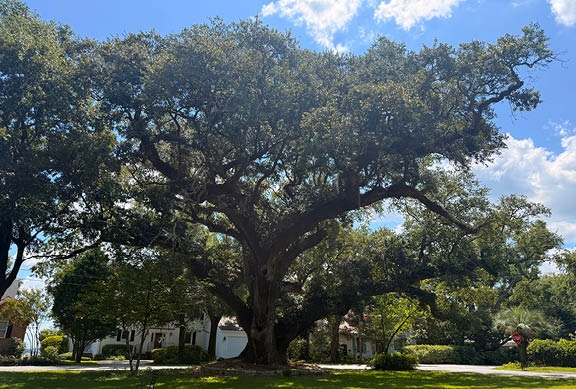
The Arcadian Park live oak is a piece of living history
by Kenneth Marolda | Member of the West Ashley Historians
Nestled in a pocket of live oak trees only a stone’s throw from Charles Towne Landing, Arcadian Park in Avondale is an oasis of calm amid the bustling development that has swept across West Ashley in recent years. An ancient live oak presides over this quiet space with limbs thicker than the trunks of most trees, and a canopy that spans nearly half a football field. In the dappled shade of its broad crown, which has sheltered the ground below for centuries, we can reflect on the many layers of history that unfolded right beneath its great limbs.
Throughout prehistory, the land that would one day become Charleston was occupied by several Native tribes: Stono, Kiawah, Etiwan, and others. These tribes called the area near Avondale “Waspawnee,” a name that still survives into modern times.
The first European colonists arrived at Charles Towne Landing in 1670, and this land would have been among the first areas they explored after they negotiated its purchase from the Cassique tribal leaders. We can only assume that the colonists were as enchanted with this magnificent oak tree as we are today, because John Godfrey chose this grove as the spot to create his family’s settlement during those very early days of the colony.
In 1672, the Godfrey house was designated as the rallying point for the colonial militia. In the event of an attack from the Spanish, French, or Native Americans, this spot was where colonists were instructed to meet to organize their defenses. In recent years, remnants of tabby and pottery have been found in the yards neighboring this tree, and archaeologists have dated some of them to the late 1600s. These weathered bits of stone and clay are tangible reminders of this early chapter of our area’s past.
Throughout the following centuries, plantation life unfolded in St. Andrew’s Parish, and the Godfrey plantation passed to new owners, many of whom maintained their residences at the house in the shade of the Arcadian Oak. During the Civil War, the plantation was owned by Martha Prioleau and her home was not spared the violence of the conflict.
While Prioleau had fled the city in advance of the confrontation between Union and Confederate forces in February 1865, the old settlement was burned by advancing Federal troops. As recorded in a letter to the Freedman’s Bureau after the war, “Everything, including almost every building on the property, was destroyed by the fire.”
Archaeologists have identified shards of 1840’s and 1850’s dishware and fine china buried in the land around the Arcadian Oak, and the charred marks still visible on them serve as testaments to the intense trauma inflicted on the landscape by the horrors of war.
Agriculture remained the way of life in St Andrews Parish until the interwar years, when the expansion of the Navy Base demanded housing for sailors and workers. When Avondale was created in 1940, a story was published in the Evening Post titled Venerable Oak Tree Centuries Old which featured the Arcadian Oak.
An arborist took measurements of the tree, estimated its age to be between 500 and 1,000 years old, and compared it to similar trees that served as prominent garden elements on other nearby plantations. Many of the families who moved into Avondale around this time worked at the base.
It was one of these workers, John Harken, who, in 1951, used Belgian blocks from the Navy Yard to build a decorative retaining wall around the base of the Arcadian Oak. This cobbled decorative wall remains to this day a whimsical reminder of the allure and charm that attracted these new suburban families who adored Arcadian Park, much like the Godfreys centuries before them.
As we now approach our nation’s 250th birthday, perhaps we can appreciate that this tree was a silent spectator to our fight for freedom, including our enduring spirit during the British Siege of Charleston. Through the ages, this magnificent tree has witnessed countless lifetimes and dozens of eras of our past. It has survived the same hurricanes and wars that have shaped our culture, and perhaps in its shade we can share a unique moment of serenity with those who came before us.


