
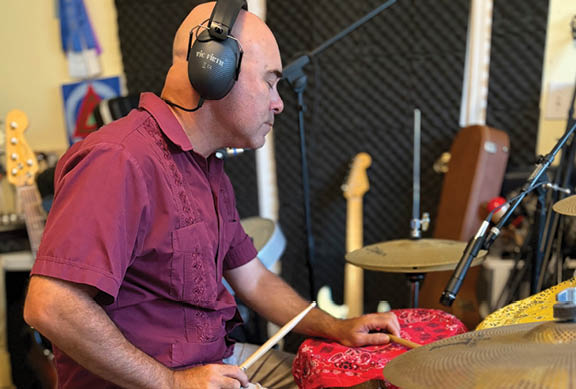
Artist, composer, and multi-instrumentalist Dayton Colie finds inspiration everywhere, even in the click of a turn signal
by Lorne Chambers | Editor
West Ashley resident Dayton Colie started playing and writing original music when he was 16.
“At the time, it did not occur to me that songs just popping up in my head were a special thing,” says Colie. It wasn’t until he ended up rooming with another musician who, after hearing some of his original songs, proposed they start a band.
“We had a great time playing all over Charleston for a few years, and that eventually led to playing bass in a jazz band,” says Colie. “Playing jazz required me to learn about how music is structured so I could improvise and sound good with a group of people.
During this period, Colie realized he could apply his musical knowledge across most instruments and play them if he practiced. This encouraged him to play as many instruments as he could get his hands on. Since then, Colie has recorded several solo albums in which he plays every instrument.
This is the case with his latest album, Signals, which Colie recorded in his West Ashley home studio and officially released to the public on June 28.
While the album delivers a unique sonic journey through rhythm, movement, and everyday inspiration, Colie says the concept began unexpectedly at a traffic light. He was sitting in his vehicle when he found himself captivated by the steady pulse of a turn signal. A melody emerged in his mind, and Colie set out to record the signals of a variety of cars, letting each character and tempo determine the foundations of each song. Every track begins and ends with the turn signal, and it remains present throughout.
“Most of my albums wind up being guided by a concept of some sort, and this one is no exception,” says Colie. I’ve learned to trust consistently persistent ideas when they happen, so I recorded the signals from one of my cars for five minutes, found the tempo, and began recording from there.”
What initially started as an exploration of whether it was possible to create a whole album of songs from this concept turned into both an analytical and emotional journey. Colie found that the analog signals of older cars have more mechanical characteristics than newer cars because the signal is caused by a physical electrical relay, often resulting in a clankier, deeper timbre, while newer signals sound lighter and clearer. While these differences did affect the writing of each car’s song, the story of the cars had a greater influence on the music.
“My neighbors were very kind and supportive about letting me record their signals as well, so it was a community effort of sorts,” says Colie. “Each song typically takes a few days to do, and it’s not uncommon for me to delete and re-do entire parts of a song,” says Colie. “Sometimes I record something and revisit it the next day, only to discover that it’s not as great as I remembered, and sometimes it magically happens on the first take.”
Colie created a custom home studio that allows him to switch from one instrument to another very quickly. He says after decades of performing live, the creativity of the recording studio is rewarding these days.
“I am finding that the creative/studio aspect is more enjoyable because my setup enables me to bring my ideas to fruition very quickly. I can explore ideas that I have, and I am able to do it easily when the time allows,” says Colie. “There are a couple things I’ve tried lately in terms of playing with other people, and I’ve learned that I need some creative space.”
Colie says as much as he enjoys bopping along on an upright bass to bluegrass music, he’s found he needs something more right now.
“With that said, I really, really do enjoy playing with other musicians, but it would need the right project/group,” he says. “I miss playing in the Zydeco band (Sidewalk Zydeco) because it was fast, fun, and I had a lot of creative freedom, while also connecting with other musicians.”
Colie says he’s also been kicking around an idea for a sort of gameshow/improv jam project that would involve other musicians.
“I actually have a few who are really interested and would be on board to try it,” he says. “Now that I’ve mentioned it, I may need to bring it to fruition soon.”
In addition to being a musician, Colie is also a visual artist.
“I claim both equally as far as my identity goes. I can’t turn off the creativity thing, so I’ve had to learn to let it work for me in whatever format it chooses at the time. I feel like I’ve done reasonably well in both fields, and it’s nice to be able to switch back and forth.” says Colie. “I also allow the music and art to work together.”
Colie, who teaches visual art at Charleston County School of the Arts, recently made a unique color theory tool that utilizes music modes/keys to help select color combinations.
“The Visual and Musical aspects of creativity both come from the same section of my brain,” he says. “Ideas frequently manifest themselves suddenly, and I write them down or remember them so I can explore them later. Sometimes things come together quickly, and sometimes I give myself a year or more to explore a concept.”
Right now, Colie is still fascinated by vehicle turn signals. He says he’s already started a second album using signals. The first song is inspired by a new Ford Bronco.


