
by Lorne Chambers | Editor
New architectural surveys of Old Windermere and Byrnes Downs reveal two remarkably intact West Ashley neighborhoods and lay the groundwork for potential National Register historic district designations
From cobblestone streets to Spanish moss-draped live oaks and church steeples dotting the skyline, Charleston’s rich history is both celebrated and fiercely protected. But what about the history on our side of the Ashley River?
After all, West Ashley is where Charleston’s story began more than 350 years ago, when English settlers established the original Charles Towne colony in 1670. It’s also home to South Carolina’s oldest continuously operating shopping center, Charleston’s oldest existing church, and historic neighborhoods that tell the story of the city’s expansion beyond the peninsula.
Now, nearly a century after Charleston began expanding west of the Ashley River, two of its earliest suburban neighborhoods are getting a closer look at the history hiding in plain sight.
From the Tudor Revival cottages and tree-lined streets of Old Windermere to the modest brick homes and carefully planned streetscapes of Byrnes Downs, the neighborhoods tell different but equally important stories about Charleston’s growth beyond the peninsula.
An extensive architectural survey conducted over the summer documents those stories in unprecedented detail, giving residents a clearer understanding of their neighborhoods’ historical significance and laying the groundwork for what could become a major milestone: inclusion on the National Register of Historic Places.
The Preservation Society of Charleston unveiled the results of the project during a community presentation titled Preservation & Progress, held on Tuesday, Oct. 20 at John Wesley United Methodist Church on Savannah Highway.
Clemson University historic preservation graduate students Croix Brown and Emily Anne Harris completed the surveys over the summer, documenting more than 500 historic structures across the two neighborhoods and examining everything from architectural styles and construction dates to building materials, alterations, and distinctive architectural features.
The research has been compiled into two publicly accessible digital StoryMaps, allowing residents to explore the history and architectural character of their neighborhoods through interactive maps, photographs, historical imagery, and illustrations. One particularly engaging feature is a “then-and-now” slider that lets users move their cursor across photographs of historic homes to see how they’ve changed, or remained remarkably the same, over the decades.
But the ultimate goal extends beyond creating an impressive historical record.
Both Old Windermere and Byrnes Downs have already been determined eligible for designation as National Register historic districts by the South Carolina Department of Archives and History. The new surveys provide much of the groundwork necessary to pursue those nominations, which would formally recognize the neighborhoods’ historical and architectural significance.
“Growth and change are an inevitable and even a welcome part of living in any community,” said Ashton Finley, an Old Windermere resident and founder of Save Historic West Ashley. “But we firmly believe that this is not a binary choice between preservation or progress. You can have thoughtful, managed growth in a city that makes room for the new while respecting the old.”
Finley helped establish Save Historic West Ashley following a community effort to prevent the demolition of a historic home at 8 Stocker Dr. Although the building was ultimately saved, the experience raised broader questions about how Charleston recognizes and protects its historic neighborhoods outside the peninsula.
Anna Catherine Alexander, director of advocacy initiatives for the Preservation Society, said the project was designed to provide residents with the information and tools needed to participate in those conversations.
“Historic preservation has always been a grassroots movement, and the people who know what makes a community special are the people who live there,” Alexander said.
The new research also builds on earlier work by the City of Charleston. In 2009, the city completed Area Character Appraisals of both Old Windermere and Byrnes Downs, identifying the architectural, historical, and landscape characteristics that distinguish the neighborhoods. The latest project builds on that documentation, surveying individual properties and creating a comprehensive digital inventory.
Two Neighborhoods, Two Chapters Of History
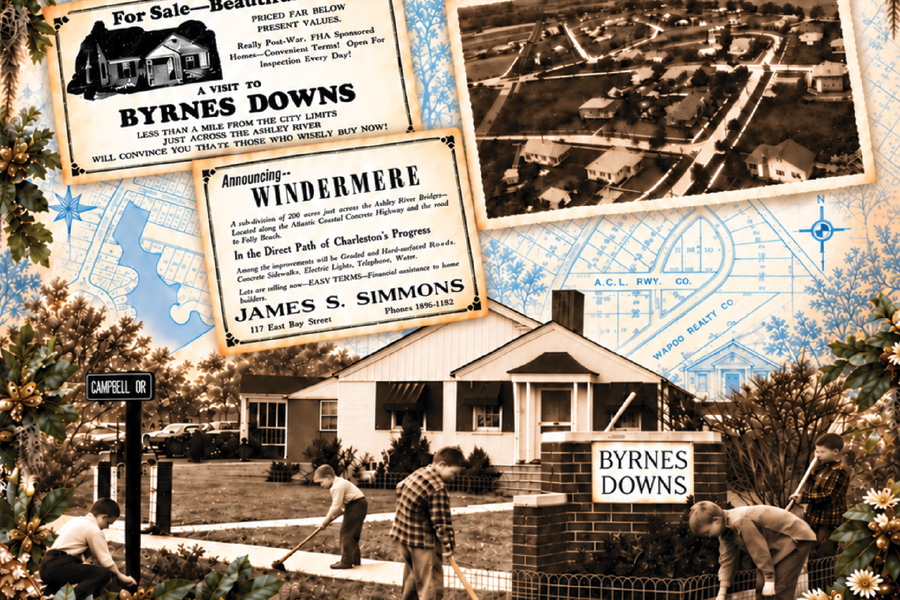
Old Windermere’s story begins in 1925, when Charleston real estate broker James Stocker Simmons purchased farmland west of the Ashley River in anticipation of the opening of the Ashley River Memorial Bridge.
The bridge, which opened in 1926, helped transform West Ashley from a largely agricultural landscape into a viable residential alternative to downtown Charleston.
Simmons envisioned a modern suburb where residents could enjoy larger lots and new conveniences while remaining connected to jobs and businesses on the peninsula.
To entice buyers from downtown Charleston, he installed electric lights, telephone lines, and improved roads, and planted live oak trees that would eventually help create the neighborhood’s distinctive canopy.
Unlike later subdivisions built around standardized home designs, Simmons sold individual lots and let buyers build houses that reflected their own tastes.
That approach produced an eclectic collection of architectural styles, including Colonial Revival, Tudor Revival, Craftsman, and Minimal Traditional homes.
The Preservation Society’s survey documented 200 buildings in Old Windermere, revealing a neighborhood whose architectural diversity is matched by a remarkable degree of historical continuity.
More than 26 percent of surveyed houses retain their original building footprints, while approximately 89 percent of buildings continue to serve their historic uses, either as residential communal, or commercial properties. The researchers also found that duplexes and multifamily residences have been part of Old Windermere’s architectural fabric since its early development.
Byrnes Downs, meanwhile, emerged from a different chapter in West Ashley’s history.
During World War II, the rapid expansion of the Charleston Naval Base and shipyard created an urgent need for housing. The V-Housing Corporation, established to address the shortage, announced plans for Byrnes Downs in 1942.
Construction began in 1944, with the neighborhood initially intended to provide rental homes for shipyard workers. By the time construction was completed in 1945, the war had ended, and the development was marketed instead to returning veterans and young families.
Although Byrnes Downs was built as a planned tract-housing development, its designers incorporated an unusual amount of architectural variety. Brown and Harris identified 14 distinct residential house types, or typologies, distinguished by their rooflines, porches, windows, and other details.
“Though it was a tract housing development, rather than repeating the same patterns along each street, the builders mixed different typologies to create a visually varied streetscape while still maintaining a cohesive architectural character,” Brown explained.
Harris hand-drew examples of each style of house, which were on display at the meeting and available on the Preservation Society’s website.
The Byrnes Downs survey documented 389 points of interest, including houses, commercial buildings, neighborhood signs, and historical markers.
The findings reveal an exceptionally intact midcentury neighborhood. Approximately one-quarter of its houses retain their original footprints, and the survey found that all residential properties have maintained their historic residential function.
A Legacy Rooted In The Landscape
Some of Byrnes Downs’ most recognizable characteristics have less to do with the houses themselves than with the residents who helped shape the neighborhood.
In 1948, just a few years after its completion, 15 women formed the Byrnes Downs Garden Club with the goal of improving and beautifying their community.
Their efforts included installing street markers, maintaining neighborhood entrances, and planting 107 oak trees, 63 crape myrtles, and several dogwoods.
Those plantings helped establish the mature tree canopy that remains one of Byrnes Downs’ defining features.
The club also left behind a valuable historical record.
The Club’s historian, May T. Rossiter, maintained a scrapbook documenting the neighborhood’s early years. The collection was later preserved by Anne Thorne and her family and eventually made available through the Lowcountry Digital Library.
During the Oct. 20 presentation, Margaret Thorne Seidler, whose grandmother, Anne Thorne, served as president of the Byrnes Downs Garden Club, shared her family’s longstanding ties to the neighborhood. Seidler also helped preserve an important piece of its history by donating the Garden Club’s scrapbook to the College of Charleston’s Special Collections, where it offers a glimpse into Byrnes Downs’ earliest years.
The archival photographs proved particularly valuable to Brown and Harris, allowing them to compare original houses and streetscapes with their present-day appearances.
Those comparisons, featured in the StoryMaps, reveal how much of both neighborhoods’ original character remains intact despite decades of change.
Seidler praised Brown and Harris for their extensive research, drawing enthusiastic applause from the audience.
“What y’all have done in terms of research is something I never imagined we would have,” she said. “Something like this that takes a snapshot of who we are, so we can make good choices based on who we are today, not just 50 or 60 years ago, but who we are today.”
Seidler also expressed her appreciation for a younger generation taking an interest in the neighborhood’s history.
“I’m so excited that young people like you, who are well educated and interested in preserving the past, are making sure we deal with things really well in the future.”
A Path Toward National Recognition
With the surveys completed, attention is now turning toward what comes next.
One of the Preservation Society’s principal goals is to pursue National Register historic district nominations for both neighborhoods.
Maintained by the National Park Service, the National Register of Historic Places recognizes buildings, sites, and districts significant to American history, architecture, archaeology, engineering, and culture.
Although Old Windermere and Byrnes Downs have already been determined eligible, formal listing would require additional steps, including preparing and submitting nominations for review.
Designation would bring national recognition to two neighborhoods that helped define Charleston’s suburban development, while potentially making qualifying preservation projects eligible for state and federal rehabilitation tax incentives.
Importantly, National Register designation is not the same as establishing a locally regulated historic district.
Listing does not prevent homeowners from renovating, expanding, or selling their properties, nor does it impose the design-review requirements associated with Charleston’s Board of Architectural Review (BAR). Separate considerations may apply when state or federal involvement triggers historic preservation review.
That distinction became an important part of the Oct. 20 discussion, when one resident expressed both interest in protecting neighborhood character and concern about potential restrictions on private property.
Local author and historian Donna Jacobs, who helped organize the meeting, emphasized that the project does not propose extending downtown Charleston’s architectural review system into West Ashley. Instead, the project provides a starting point for considering approaches that reflect the history, design, and needs of suburban neighborhoods.
“The first step is the National Registry because it is an honorary distinction, and it’s a very important step,” Jacobs said, emphasizing that it has nothing to do with the BAR.
The organization is seeking input from residents interested in pursuing National Register nominations, with forms available through the project materials.
“The result is much more than a collection of data,” said Laurel Fay, the Preservation Society’s manager of preservation and research. “It is a community resource that documents the history, architecture, and character of these neighborhoods and provides a foundation for future conversations about preservation and planning.”
For Old Windermere and Byrnes Downs, those conversations could eventually lead to formal national recognition. For West Ashley as a whole, the project offers something equally important: a more complete understanding of how Charleston became the city it is today and our community’s role in that evolution.
It’s also a reminder that some of Charleston’s most meaningful history isn’t found behind wrought-iron gates or along cobblestone streets, but in the houses, gardens, and neighborhoods where generations of families have made their homes west of the Ashley River, where Charleston’s story began more than 350 years ago.
“This was our third Preservation & Progress, and we are making progress,” Jacobs said. “So, watch out National Register, because here we come.”
To explore the architectural surveys and interactive StoryMaps for Old Windermere and Byrnes Downs, visit www.preservationsociety.org/programs-resources/surveys-and-inventories/.


