
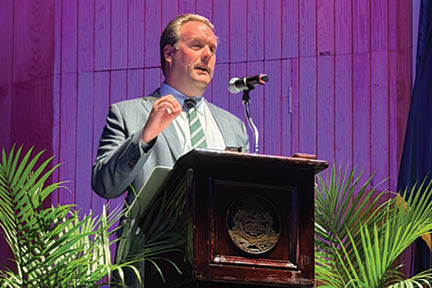
Mayor Cogswell kicks off a series of State of the City Addresses at WAHS
by Lorne Chambers | Editor
For decades, West Ashley residents have asked, “What about us?” as much of City Hall’s attention seemed focused on the Peninsula. But last month, City of Charleston Mayor William Cogswell sent a different message.
Not only did he decide that one single “State of the City” address would not suffice, but the mayor kicked off his string of community-specific presentations in West Ashley.
On Tuesday, Sept. 15, Cogswell spoke to a large group of residents at the West Ashley High School auditorium as part of the city’s new “State of Our City” series. West Ashley was the first of five stops planned across Charleston this fall, followed by Johns Island, Daniel Island and Cainhoy, James Island, and, finally, the Peninsula.
The format allowed Cogswell and West Ashley City Council members to focus specifically on projects and issues affecting residents west of the Ashley River, while also giving residents an opportunity to submit questions and speak with city staff.
The presentation’s 5:30 p.m. start put many in the increasingly busy West Ashley rush hour traffic. So, it was no surprise that transportation was a major topic.
Among the biggest announcements was a new agreement between the city and the S.C. Department of Transportation (SCDOT) that will allow Charleston crews to repair potholes on state-owned roads. Roughly half of the roads within Charleston are controlled by the state, which previously meant city crews could not simply repair a pothole even when it was within city limits.
Under the new agreement, the city says its crews will be able to repair 20 to 30 potholes a day and will add a second repair crew and truck. Beginning in early 2027, residents will also have access to a dedicated hotline for reporting potholes.
The city also announced it has secured funding through the Charleston Area Transportation Study (CHATS) to retime every traffic signal in West Ashley in an effort to improve traffic flow. Cogswell pointed to a similar signal-retiming project along the Calhoun Street corridor, which they say improved traffic flow by roughly 25 percent.
“It all comes down to the same goal: making our roads work better for the people who use them every day,” Cogswell said. “We’re cutting through red tape with our state and regional partners to get it done.”
Beyond roads and traffic, the broader State of Our City series is intended to give residents a closer look at neighborhood-specific work involving infrastructure, public safety, recreation, housing, growth, and quality-of-life issues.
For West Ashley residents accustomed to wondering when their part of Charleston would get its turn, there was at least some symbolism in the schedule.
This time, West Ashley went first.


