
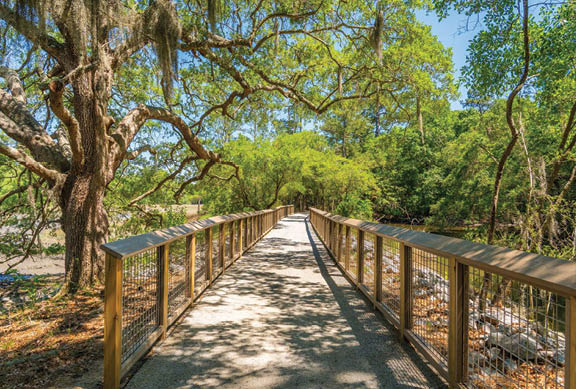
Old Towne Creek County Park opens beside the birthplace of South Carolina’s first permanent European settlement
by Matt Poust | Contributing Writer
Just days before Americans celebrate the nation’s 250th birthday, West Ashley has officially unwrapped a gift of its own.
On June 30, Charleston County Parks and Recreation opened Old Towne Creek County Park, inviting the public to explore a landscape that’s filled with natural beauty and history that predates the United States by more than a century.
Before there was Charleston. Before Rainbow Row, the Battery, or Market Street. Before there was even an America.
There was Old Towne Creek.
In 1670, English settlers navigated these tidal waters while establishing Charles Towne, South Carolina’s first permanent English settlement. The creek formed part of the fledgling colony’s western boundary and natural defenses, while its quiet waters served as an everyday thoroughfare for settlers traveling between the settlement and the Ashley River. Supplies arriving by ship moved through these surrounding waterways, and archaeologists continue to study the area today because it remains one of the most historically significant colonial landscapes in the state.
Nearly 350 years later, visitors can once again walk this same ground.
The 67-acre park blends recreation with interpretation. Visitors will find walking trails, elevated boardwalks, scenic marsh overlooks, an arboretum, and a nature-inspired playground, all designed to encourage exploration of both the landscape and the stories it holds. Interpretive exhibits and signage throughout the park introduce visitors to the people, cultures, and events that shaped West Ashley long before it became the suburban community it is today.
The property itself reflects another chapter of local history. Many of the flowering ornamentals that bloom throughout the park were planted decades ago by mother and daughter Emily Simmons Ravenel and Emily Ravenel Farrow, whose beloved Ashem Farm occupied the land for generations.
Farrow, a noted preservationist, historian, and equestrian, ultimately ensured the property would remain protected through conservation easements before entrusting it to the Lowcountry Land Trust. Charleston County Parks later acquired the site, fulfilling her vision that the land remain a place for education, recreation, and quiet reflection rather than another subdivision. Today, the Lowcountry Land Trust’s Center for Conservation stands next door, continuing that legacy of stewardship.
Whether visitors come to walk beneath centuries-old live oaks, enjoy a picnic overlooking the marsh, let children explore the playground, or simply spend a quiet afternoon outdoors, Old Towne Creek County Park offers something increasingly rare: an opportunity to experience the landscape where South Carolina’s story began. It offers perspective.
As communities across the nation commemorate America’s Semiquincentennial, the park reminds visitors that the story of the United States did not begin in 1776. It began with places like this, where settlers first carved out communities that would eventually become the colonies—and later, the states—that formed the nation.
The land’s preservation is due in large part to Charleston preservationist, historian, and equestrian Emily Ravenel Farrow. Long before land conservation became commonplace, Farrow placed much of the property under conservation easements and worked to ensure it would never become another subdivision.
For a community often defined by rapid growth, Old Towne Creek County Park represents something increasingly uncommon—not simply open space, but protected history.
Children may come to climb the playground. Families may come to walk beneath sprawling live oaks or pause over sweeping marsh vistas. But whether they realize it or not, they’ll also be standing on ground where generations of Native peoples lived, where English settlers first navigated the Lowcountry’s tidal creeks, and where one of America’s oldest stories quietly began.
Old Towne Creek County Park is located at 1400 Old Towne Road. Admission is $2 per person, with free entry for Gold Pass members and children ages 2 and under.
For more information, call (843) 795-4386 or visit www.ccprc.com.


