
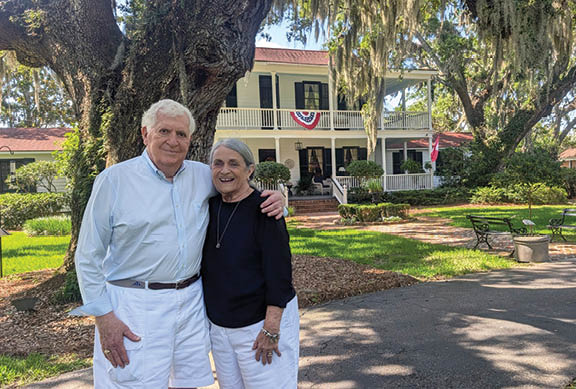
West Ashley family lives on the former Wappoo Plantation where Eliza Lucas Pinckney cultivated indigo
 In 1739, a 16-year-old girl was left in charge of her family’s plantation on Wappoo Creek. Following Betsy Road to its intersection at Lord Calvert Drive, you will find a plaque installed on a brick pillar commemorating the location where indigo seed was planted by Eliza Lucas in 1741.
When her father, George Lucas, reported for military duty in the West Indies in 1739, he left Eliza responsible for three, near-bankrupt rice plantations in South Carolina. The idea of a teenager managing not only the Wappoo Plantation but two others, at that young age would be unlikely at any time, but Eliza was an unusual girl. She was traditionally educated in England, learning French, music and botany, but she had a curious mind and a lifelong love of horticulture.
Sensing the urgency to turn around the family fortunes, Eliza sought the advice of family friends Charles and Elizabeth Pinckney in the city and often visited them in Charleston
Eliza’s father sent seeds to Eliza from Antigua for experimentation during their first year apart. In 1740, he sent indigo. Her first attempts were discouraging as fire, frost, and worms destroyed her crop. It took three years of experimentation and setbacks, but Eliza, along with an enslaved worker named John Quash Williams, finally proved that indigo could be successfully grown and processed in South Carolina. She shared her methods with neighbors hoping to increase interest in Carolina indigo trade.
By 1747, 134,000 pounds of indigo had been shipped to England generating fortunes for Eliza and her neighbors. Before the American Revolution, indigo accounted for 1/3 of the trade between the colonies and England, and Charles Town was the wealthiest city in the colonies.
When her friend Elizabeth passed away, she married her widowed husband and long time friend Charles Pinkney, describing him in letters as, “He was the best of husbands; the greatest of friends.”
They had four children. Their eldest son was Charles Cotesworth Pinckney, a signer of the US Constitution and two-time candidate for President of the United States.
John Quash Williams played a major part in the success of indigo, but was known as a master carpenter. He was later assigned the task of building the Pinckney Mansion in Charleston. Finished in 1750, his skill was on display for all of Charleston to see. In May of that year Charles and Eliza Lucas Pinckney freed Williams from slavery and he successfully supported himself as a carpenter and builder.
Eliza became an enthusiastic supporter of the Revolution. She spent much of her time with her daughter Harriott Pinckney Horry at Hampton Plantation near Georgetown where she met the “Swamp Fox”, Francis Marion. Eliza helped host George Washington at Hampton Plantation during his 1791 visit.
She traveled to Philadelphia for breast cancer treatment in 1793. She died and was buried there with George Washington serving as one of her pallbearers.
I wrote to my friend, writer and artist Diane Coleman, who published the beautifully illustrated True Indigo: An Illustrated Biography of Eliza Lucas Pinckney, Planter & Patriot, and asked what Eliza herself had to say about.
In her words, “Wappoo, with its 600 acres, was the smallest of the plantations and it was the closest to Charles Town. Wappoo lay along the north bank of Wappoo Creek, only an hour-long boat ride from town, ‘six [miles] by water’ or ‘17 mile[s] by land,” Eliza wrote to a friend. “Wappoo,” she continued, “our place of residence in the country, stood around a deep bend in the creek.”
Some still called it The Bluff for the low creek bank where the house stood only 10 feet above the wide creek. The plantation had been purchased by Eliza’s grandfather, John Lucas, in 1713.
The house was simple but dignified and grand enough, probably built of wood and tabby, a mixture of sand, water and broken oyster shells. The design was typical of the lowcountry settlers from the West Indies.
Eliza Lucas Pinckney was a remarkable woman and changed the course of South Carolina’s place in history.
Ever curious myself, I went to check it out.
I messaged the current owners of the property, Bill and Audrey Moody, baked shortbread and knocked on their door.
The original house is long gone, but their beautiful, welcoming home full of memorabilia, photographs and memories of a full family life was built in 1870 and a wide porch looks over the same marsh view that Eliza loved. They spoke of the deep sense of calm they felt simply entering the property. Under the ancient oaks, there remains a giant upturned iron cauldron. They denied any sense that it might be haunted, but both describe sensations of goodwill and affection on the property. The porch was decorated with patriotic bunting for the upcoming holiday festivities.
Eliza Lucas Pinkney would be pleased.
I am no historian, but there are many books about Eliza Lucas Pinckney. The Charleston Museum is currently displaying a restored Robe a la Francais gown believed to have been made in 1753. There are lectures, walking tours and Indigo Dyeing classes where you can try your hand at learning the process.
The Indigo Girl by Natasha Boyd: A gripping historical fiction novel based directly on her life and early experiments with indigo.
The Letterbook of Eliza Lucas Pinckney, 1739-1762 edited by Elise Pinckney and Marvin R. Zahniser: A compiled book of her own letters. It provides an intimate, first-hand view of her daily interests, reading habits, and thoughts on plantation life.
True Indigo: An Illustrated Biography of Eliza Lucas Pinckney, Planter & Patriot, by Dianne Coleman. This book details the life of the 18th-century icon who revolutionized South Carolina agriculture by successfully cultivating indigo.
Stay healthy, my friends, and wave at me as I wander. Send ideas for upcoming columns to westashleywanderer@gmail.com.


