
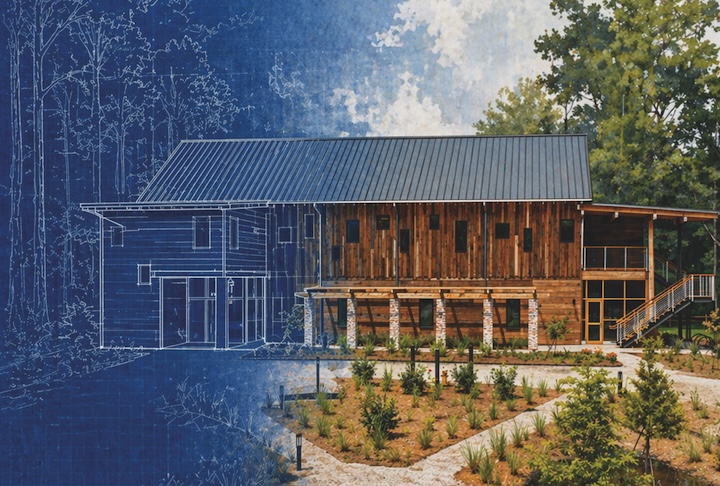
Lowcountry Land Trust’s new West Ashley hub wins Carolopolis Award for sustainable design that blends into the landscape
by Matt Poust | Contributing Writer
In a region where growth often tests the balance between development and preservation, one West Ashley project is showing how the two can work together.
The Lowcountry Land Trust’s Center for Conservation was recognized with a Carolopolis Award for New Construction on Feb. 27, a ceremony presented annually by the Preservation Society of Charleston. Established in 1953, the awards honor outstanding achievement in historic preservation and design across the Charleston area.
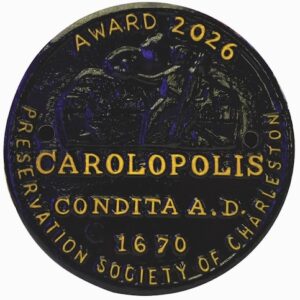 The Center for Conservation was one of six projects to receive the new construction award this year – and the only recipient in West Ashley. For the Lowcountry Land Trust, the recognition is both an honor and a reflection of a much larger story rooted in the land itself.
Decades before the center was built, the 55-acre property it sits on – once known as Ashem Farm – was shaped by the vision of its former owner, Emily Ravenel Farrow. As a dedicated historian and conservationist, Farrow worked with the Historic Charleston Foundation to place the land into conservation easements before her passing in 2011, ensuring it would be protected for generations.
Today, that vision is still unfolding. Of the 55 acres, 51 are set aside for the Old Towne Creek County Park that will soon be open for public access. The remaining four acres became home to the Low Country Land Trust and its Center for Conservation – a space designed not just as an office, but as a hub for education, outreach and collaboration among conservation groups.
The site also sits within a broader network of protected land in West Ashley, near places like Charles Towne Landing and the Native American Ceremonial Site, creating a kind of green corridor tucked into an otherwise vastly-commercialized area.
Valuing this site’s idyllic surroundings and keeping Farrow’s vision in mind, the Land Trust planned the center’s development with intention. They didn’t want something that stood out, but something that fit in.
Local firms Reggie Gibson Architects and Willis Hagood Construction were contracted to design a building that reflects both the natural surroundings and the Lowcountry’s architectural traditions.
This meant using materials rooted in the region. Reclaimed brick from a former structure on King Street, pine siding salvaged from a 1918 Georgia schoolhouse in Augusta, and cypress paneling throughout the interior stand out as defining elements of a final project woven into the history of the land it sits on.
With befitting building materials, the other half of the executed vision for the project meant letting the landscape lead.
“The project thoughtfully incorporates sustainable features – it’s sited on the highest ground of the parcel, preserves much of the existing vegetation and uses native plants in the landscaping,” said Madison Lee, Community Outreach Coordinator for the PSC.
Just as important, Lee said, is how the building responds to its surroundings.
“Rather than mimicking nearby buildings, the project takes cues from its setting – nestled quietly into the site and designed to complement the natural environment.”
According to Lee, the center for conservation along with the other recipients of the new construction award at this year’s Carolopolis Awards are becoming more important and more noticeable as their surrounding areas continue to grow.
“Charleston is growing rapidly, and with that comes a wave of new development,” Lee said. “When those projects fit their context – rather than feeling intrusive – it shows that growth and preservation don’t have to be at odds.”
On top of seeing projects that weren’t just restoring architectural history, but adding to it, the geographic span of those projects is also covering a majority of the Charleston region. The list of this year’s Carolopolis winners stretched from downtown Charleston to Sullivan’s Island, Edisto Island, Park Circle and West Ashley. For Lee, recognizing projects outside the peninsula is especially meaningful, since those areas often don’t have the same level of historic protection.
Responding to what this award means to the Lowcountry Land Trust, President and CEO Matt Williams stated that it isn’t just about the recognition, but how it carries on the ideals that started with Farrow.
“It’s an incredible honor to receive a Carolopolis Award,” Williams said. “It raises our profile in a positive way, but it also gives us an opportunity to honor and share Emily Ravenel Farrow’s vision for this property.”
That vision, Williams said, was simple at its core: protect the land as it was – a peaceful place filled with forest, marsh, Old Towne Creek and wildlife – and create a space where conservation work could thrive.
“The Lowcountry Land Trust is proud to achieve both of those objectives,” Williams said, “by protecting the property forever and by opening the Center for Conservation.”
Since moving into the building in August 2025, the organization has already seen the impact. Designed to encourage collaboration, the space has helped bring staff and partners together in new ways.
That momentum carried into a milestone year. In 2025, the Land Trust closed on 19 projects and protected 2,275 acres across its focus area, balancing public access with privately held conservation easements.
Williams said having a dedicated, welcoming space played a role in that success.
“When you have a place that’s designed for collaboration, it makes a difference in how people work together.”
The broader property, developed in partnership with Charleston County Parks, is also opening new opportunities for the public to connect with nature – something Williams believes people are craving more than ever.
“People need to get outdoors and experience the trees and nature and encounter all that it offers,” he said. “When you do that, it’s good for your soul.”
Looking ahead, Williams sees the Center for Conservation as a place where future ideas and protections will take shape.
“I have no doubt that there will be discussions and ideas and agreements reached here that will protect what’s special about the Lowcountry.”


