100 feet below the Greenway, Charleston Water System’s massive $135 million sewage project will change West Ashley forever
by Lorne Chambers | Editor
When talking about the revitalization of West Ashley, most people speak in terms of improvements to buildings, streets, and sidewalks. They hope for new restaurants and retail centers, muttering rumors and hoping that a certain elusive grocery store will one day make its way to our side of the Ashley River. But the largest and arguably most important revitalization that’s taking place in West Ashley is happening right now, and most people have no idea. That’s because it’s going on 130 feet underground.
It’s down here, in the dense layer of clay known as the Cooper Marl, where Charleston Water System (CWS) crews are working around the clock on a $135 million project that will significantly upgrade West Ashley’s moribund sewer system, shoring it up for decades to come. When it began in earnest last summer, the massive job was the most expensive capital project CWS had ever taken on. Now, it is the second most expensive, with the Hanahan Water Treatment Plant improvements coming online and tipping the scales at around $150 million.
The West Ashley project, which is slated to be completed sometime in late 2027, includes 20,000 feet of tunnel that will carry 100 percent of the raw sewage from West Ashley, Johns Island, Hollywood, Ravenel, and Meggett through complete build-out of those communities for 50 years, and maybe more than 100 years, according to Mike Saia, Director of Communications for CWS.
According to Saia, one of the goals of the plan is to significantly reduce sewer overflows during heavy weather events in many other areas of West Ashley by reducing flow restrictions at new tunnel entry points, especially at sewer overflow hotspots. The project will drastically reduce or eliminate sewer overflows in Brynes Downs, Windemere, and South Windemere neighborhoods.
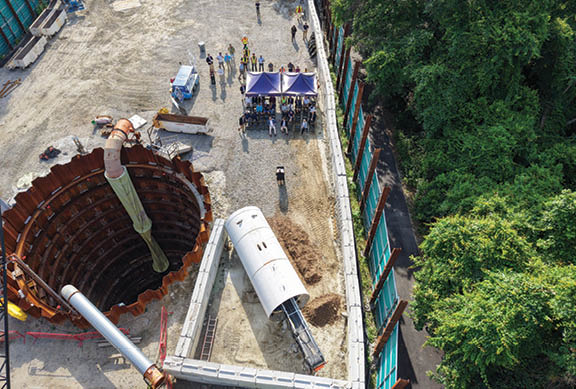
The new pipes are not only much wider, but will run much deeper, between 100-130 feet. The tunneling portion of the project was recently completed when a massive boring machine named Miss Harper broke through the receiving shaft near Culver Avenue in the Air Harbor Neighborhood, completing the tunnel’s most technically demanding phase. Miss Harper reached her destination roughly three weeks ahead of schedule and within budget, a rare feat for an infrastructure project of this magnitude
The next phase of the project is the placement of more than 1,000 sections of 60-inch fiberglass-reinforced polymer (FRP) pipe inside the completed tunnel, followed by grouting the space between the pipe and the tunnel wall.
Just days after Miss Harper broke through, CWS offered members of the press a chance to be lowered by crane 130 feet into the shaft to get a first-hand look at the magnitude of the project, which isn’t the only major improvement CWS is undertaking in an effort to bolster our sewage system for the foreseeable future. In total, about $200 million in upgrades are taking place throughout West Ashley.
“We’re bringing roughly $200 million in sewer improvements to West Ashley, and that’s really about protecting West Ashley, keeping people safe and healthy, and protecting the environment,” said Saia.
Inheriting a Ticking Timebomb
“We’re focusing a lot on West Ashley, and there’s a reason for that: we try to focus on where our risks are the highest,” said Baker Mordecai, CWS’s Chief Operating Officer. “And certainly, it’s an older system over in West Ashley. We inherited some of that system from the old St. Andrews and that created some challenges. Along with the normal challenges that a utility has.”
To understand why Charleston Water System is digging a tunnel 130 feet beneath West Ashley, you have to go back three decades. In 1995, the utility assumed control of the St. Andrews Public Service District’s troubled wastewater system under a state consent decree after years of aging infrastructure, rapid growth, and deferred maintenance had left the network plagued by sewer overflows and environmental violations. It inherited a system that, in many places, was already experiencing failures and struggling to keep up with the community it served.
Adding to the stress on the West Ashley system, the region has experienced tremendous growth over the last 30 years and is primed to see even more with major developments like Long Savannah coming down the pike.
Since taking over, CWS has invested hundreds of millions of dollars repairing, replacing, and expanding West Ashley’s sewer infrastructure. Pump stations have been modernized, aging pipelines rehabilitated, and countless smaller improvements made throughout the system. But engineers knew the greatest bottleneck remained the transmission line carrying wastewater beneath the community to the Plum Island Wastewater Treatment Plant.
All of this has helped reduce the amount of infiltration into the system, explained Mordecai.
‘Over 10 years, from 2015 to 2025, we’ve increased the number of active accounts by 18.2 percent (in West Ashley), but our flow rates have stayed essentially flat because we’ve removed so much infiltration and inflow from the system,’ said Mordecai, referring to fixes made that help prevent additional water from getting into the system through breeches and failures in both public and private lines.
The work taking place right now in West Ashley represents the culmination of that long-term effort. Rather than continuing to patch an aging system, the new deep tunnel is designed to dramatically increase capacity, improve reliability, and help prevent sewer overflows for decades. Much of West Ashley’s older sewer system was built decades ago using vitrified clay pipe and smaller-diameter mains that were never designed for today’s population. The new deep tunnel and 60-inch transmission main are intended to dramatically increase capacity while reducing overflows during heavy rain events.
The tunnel isn’t the only major wastewater improvement on the horizon. Charleston Water System is also preparing to replace Regional Pump Station 39 near the intersection of S.C. Highways 61 and 171. Built by the former St. Andrews Public Service District in 1986 and inherited by CWS after it assumed control of the troubled wastewater system in the 1990s, the aging station has reached the limits of its useful life. The planned $9.7 million replacement will provide a modern regional pump station with greater reliability and capacity to complement the new tunnel.
The Pump Station 39 upgrade is a huge part of the overall plan. Because the Lowcountry does not have large topographic variation, wastewater has to be pumped from one station to the next.
Another part of fixing the problem involves improvements being made to screening facilities, which help keep things like wipes from jamming up the sewer lines.
A Total Wipe Out
In an ideal world, Mordecai says no one would flush wipes down their toilet. They are the single biggest problem for the system getting clogged up. But since CWS can’t control what people do in their own home or what they choose to flush, CWS took the fight directly to the wipe makers and retailers.
For years, the major makers of the wipes marketed them as ‘flushable,’ but they weren’t actually flushable in the way consumers assumed. Unlike toilet paper, many of these wipes stayed intact after being flushed, snagging on roots, grease, and imperfections inside sewer pipes. They accumulated into massive clogs that jammed pumps, blocked sewer lines, and caused sewer overflows. Charleston Water System estimated it was spending hundreds of thousands of dollars each year removing wipes from its wastewater system. Those costs were ultimately passed on to the customer.
Five years ago, CWS filed a federal class-action lawsuit on behalf of wastewater utilities across the country against major manufacturers and retailers, including Procter & Gamble, Kimberly-Clark, Costco, Walmart, CVS, Walgreens, and Target, arguing that companies were deceptively marketing wipes as ‘flushable’ even though many did not break apart quickly enough to move safely through sewer systems.
Instead of simply seeking money damages, CWS sought to change the products themselves. The resulting settlements ensured that manufacturers and retailers that labeled wipes as ‘flushable’ met rigorous, internationally recognized flushability standards. It also required that non-flushable wipes be clearly labeled so consumers know they belong in the trash, not the toilet.
While the lawsuit was a huge victory for utilities worldwide, the habits wipes created over the past 20 years are still causing problems for sewer utilities. Many consumers are still flushing plastic-based non-flushable baby wipes and make-up wipes, even though they now clearly contain “Do Not Flush” graphics on their packaging. These build up and eventually become a serious problem, requiring CWS members to use giant rakes to clean off the bar screens at screening stations, often during dangerous weather events when pressure is at its peak.
Offering a Helping Hand
While the new tunnel will dramatically increase the capacity of West Ashley’s sewer system, Charleston Water System knows that solving the problem requires more than one massive infrastructure project.
Many older homes throughout West Ashley are still connected to the public sewer system by original vitrified clay service lines. Over time, those aging pipes can crack, separate at the joints, or become clogged with tree roots, allowing groundwater to seep into the system during heavy rain events. That extra water, known as infiltration, takes up valuable capacity that should be reserved for wastewater.
Replacing those aging clay laterals with modern PVC pipe would significantly reduce that unnecessary burden. But because the service lines are located on private property, the responsibility typically falls on the property owners.
To help address the problem, Charleston Water System is launching a pilot program this month that will provide qualifying homeowners with up to $2,000 to replace their aging vitrified clay sewer laterals. According to Mordecai, that’s enough to cover the average cost of replacing about 25 feet of pipe, allowing many homeowners to modernize their sewer connection at little or no cost.
“It’s a win-win,” Mordecai said. “We get callouts 24/7. We’ll inspect the system and find laterals that are in terrible condition. We’ll tell the homeowner, ‘You’ve got to do something about this.’ Most people will make a small repair, but they don’t replace the whole lateral, so they’re faced with the same problems again in the future. This gives us a way to really help the customer, but it also helps us.”
Every failing clay lateral that’s replaced means less groundwater entering the sewer system, less strain during storms, and better performance from that new $135 million tunnel. It’s a nice example of how even a project happening 130 feet underground still depends on what’s happening in homeowners’ front yards.
According to Mordecai says CWS has earmarked $50,000 for the pilot program, which will be awarded on a first-come, first-served basis. The 25 feet of PVC pipe from your home to the public sewer line may seem like a short distance compared to the 3.8 miles of 60-inch pipe currently being laid underground across West Ashley, but it’s all part of what Saia calls CWS’s ‘holistic approach’ to fixing West Ashley’s long-standing wastewater problems.
Most conversations about West Ashley’s future will likely continue to focus on new restaurants, revitalized shopping centers, and road widenings. Meanwhile, 130 feet below the Greenway, a $135 million investment is quietly laying the foundation that makes all of that growth possible. It’s not the kind of project that grabs headlines every day, but long after today’s ribbon cuttings and grand openings have faded from memory, it may prove to be one of the most important investments the community has ever made.


