
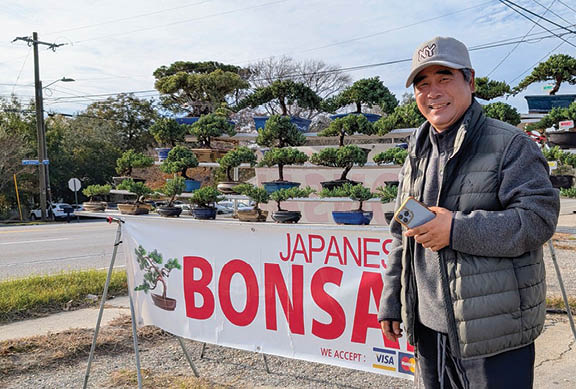
Catching up with West Ashley’s “Bonsai Guy”
by Joan Perry | Contributing Writer
 Most of my West Ashley Wandering is done on foot, but every December, driving along St. Andrews Boulevard, I spy a Japanese Bonsai sign and stand. It’s a quick flash in the corner of my eye on the way to Publix or Charlestown Landing, and I can never recall exactly where it was.
I soon noticed the topic popping up on neighborhood social media with “Did you see the Bonsai guy?” questions.
I tracked him down, set up in an empty lot across the highway from the Hamby’s Market area. Mr. Sunny Kim should be back in Texas now, feet up, relaxing with his wife and daughter and enjoying a well-deserved break, but his presence has become part of our annual West Ashley holiday tradition.
Sunny’s brother has been growing the miniature Bonsai trees for forty years, while Sunny fills his van and takes them on the road. His territory covers the east coast from Boston to Florida, wisely going north in the summer and conveniently arriving in Charleston before Christmas.
His Bonsai trees are Junipers, starting at my budget of $25 on the bottom shelf and getting pricier for the bigger trees. Each purchase comes with a sheet of instructions about recommended light, moisture and air circulation. Sunny reassured me that mine would last in its current pot size for 2-3 years. Junipers are popular because they can be made to look like a Bonsai faster than some other trees.
Bonsai is the art of growing to keep plants small and control their shape by pruning, clipping, tying, root pruning, wiring into shape, etc. to shape and preserve the miniature growth. Mature Bonsai trees are breathtakingly beautiful. Some are many hundreds of years old and have received dedicated care and attention practically every day of their lives. Most of us won’t be successful, but it’s hard to resist trying.
Curiosity led me to find out what we had locally after the Bonsai Man left town. Brandon Walker in Mt. Pleasant shared the information about Lowcountry Bonsai.
“I received (and promptly killed) my first bonsai when I was a freshman in college about 20 years ago. I had several other trees throughout the years, but it wasn’t until the pandemic when I began to deeply study the art of bonsai.”
He soon learned that despite the Lowcountry’s rich plant culture, there wasn’t a local bonsai nursery serving the area. From there, Lowcountry Bonsai was born.
Today, Brandon operates out of his backyard, offering trees, tools, and supplies for all skill levels. Inventory includes locally collected material and trees sourced from established growers around the country. While they don’t have a storefront, folks can book appointments to visit the nursery, and they ship nationwide.
Beginner bonsai workshops are held throughout the year at local venues, with the goal of introducing the art of bonsai in an approachable, easy-to-understand way. The next workshop is on Saturday, Jan. 24, at Firefly Distillery in North Charleston. An experienced instructor will guide participants through the process – from wiring and pruning to watering and long-term care. You will leave with a beautiful bonsai and the confidence to help it thrive. All materials will be provided. Participants are invited to bring their curiosity and a willingness to slow down, connect, and create.
Brandon anticipates that 2026 will be a year of growth for the business of tiny trees. “We’ve purchased a small farm, previously used for cut flowers, that will allow us to expand our selection and begin growing more of our Bonsai material locally. The early part of the year will be focused on restoring the land and preparing it for long-term growth.”
The best way for people to connect with the homegrown shop is through their website (lowcountrybonsai.com) or Instagram (@LowcountryBonsai).
Happy New Year to all. Stay healthy my friends, and wave at me as I wander Send ideas for upcoming columns to: westashleywanderer@gmail.com.


