
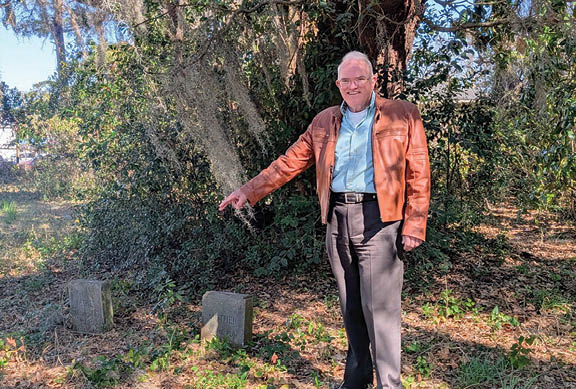
Finding Geddes Hall Cemetery is like stepping back in time
 Jealousy isn’t an attractive trait, but the enthusiasm of our West Ashley Historians as they share their excitement about every new discovery has made me sad that I didn’t have such inspiring, enthusiastic history teachers when I was in school.
Our neighborhood team of history detectives includes Charlie Smith, Diane Hamilton, Donna Jacobs, Kenneth G. Marolda, Ina Bootle, and Grant Mishoe. They meet monthly and call each other in between to share exciting nuggets of information they’ve discovered. They regularly present on topics related to West Ashley at the Hurd/St. Andrews Library on 1735 N. Woodmere Dr.
Trotters Restaurant is their regular hangout, so when I asked Charlie Smith if he had anything of interest for this month’s West Ashley Wanderer column, we met at the famous Savannah Highway soup & salad bar, and he caught me up on recent information they had uncovered about the small overgrown cemetery on Pebble Road, just off Stinson Drive.
We headed there after lunch. I immediately spotted a couple of tombstones, while Charlie pointed out others tucked under the wild vegetation. The names on the tombs will mean most to the West Ashley “Binya” crowd of locals.
From Charlie’s notes:
Locally referred to as the “Geddes Hall” or “Pebble Road” Cemetery, the small burial ground in the DuPont Community of Geddes Hall has recently been found to have a much earlier history than anyone knew. The cemetery existed 20 years before the Geddes family bought what became known as “Geddes Hall” from the heirs of John Godfrey IV.
In his will of 1784, the fourth John Godfrey stated: “… also I give at the Sandy Bay, twenty foot square for a Buering [sic] place for my last wifes [sic] fammiley [sic]”. The exact location of the cemetery is shown on a 1797 Purcell plat, which depicted the lands of two of the four heirs of Richard Godfrey IV. They were his son, John Godfrey IV, and daughter Elizabeth Godfrey Rivers.
When John Godfrey IV wrote his will in 1784, he divided all of his properties between his four surviving children, Susannah, Benjamin, Elizabeth Godfrey Quarterman, and John Godfrey V, should he [John Godfrey V] “be allowed to come in this State of South Carolina to live”.
John Godfrey V was only recently documented as a member of the British “Colleton Militia” during the American Revolution. He is listed on the “Accounts of Stoppage” as being a refugee patient at the British Hospital in Charleston for the last quarter of 1781. There seems to have been a serious question in 1784 as to whether John Godfrey V would be banished by the Legislature from the new “State of South Carolina”.
Also, in his 1784 will, John Godfrey IV made provision for another cemetery for his children and their descendants under an “old pear tree” at another of his properties. He made it clear in the will that the Sandy Bay cemetery was reserved for the children descended from his last wife, Patience Elizabeth Hutchins Dela Chappelle Godfrey, and her first husband, James Dela Chappelle, who had died in 1760. The only surviving child of record that has been identified from this marriage is a son, John Gabriel Dela Chappelle, who served the American cause in the South Carolina Continental Regiment of Artillery, under Capt. John Wickly. [Note: If this is the case, this cemetery may be eligible for at least a headstone or memorial stone for him through the VA.]
In the first quarter of the 19th century, the Sandy Bay properties belonging to the heirs of Elizabeth Godfrey Rivers and to the heirs of her brother, John Godfrey IV, were conveyed to John Geddes, later a State Representative, State Senator, Intendant of the City of Charleston, and Governor of South Carolina. These conveyances included the house that came to be known as “Geddes Hall”, even though it had been built prior to 1797 by Mary Lining, a daughter of Elizabeth Godfrey Rivers. Several other large parcels, also belonging to or once belonging to the Godfrey family, were later conveyed to John Geddes. All of them together eventually became known as “Geddes Hall”, though they had all once been owned by the Godfrey family.
There are likely no pre-Civil War Geddes family members buried in the Pebble Road cemetery. The original 1784 2×20 cemetery plot apparently did not convey to John Geddes with the larger property and may never have been conveyed to his family. The early 19th-century Geddes family members were mostly buried at First (Scots) Presbyterian Church.
The original 1784 20×20 Godfrey Dela Chappelle plot was informally expanded in the 19th century by Geddes’s descendants to its present size of 4/10ths of an acre. The parcel was first legally defined when the neighborhood surrounding it was re-platted in the mid-20th century for a housing development by the widow of Gilbert Geddes DuPont, Mrs. Minnie Lee Warren Platt DuPont Cole. There are many unmarked graves in this cemetery, both in the original plot and in the expanded area. The burials in the extended portion of the cemetery date from the late-19th to the mid-20th century and are all Geddes descendants.
Stay healthy, my friends, and wave at me as I wander. I’m not always haunting cemeteries. Send ideas for upcoming columns to: westashleywanderer@gmail.com.


