
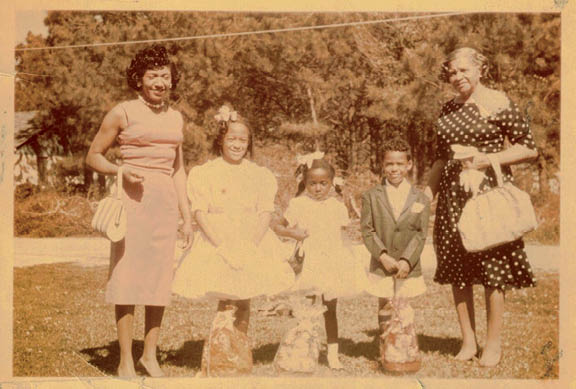
A historically Black West Ashley neighborhood remembered through the extraordinary people who called it home
 Washington Park is a lovely neighborhood adjacent to Maryville, bounded by Playground Road and tucked behind Café Roca and The Corner Store. Its history is a bit different from other St. Andrew’s Parish neighborhoods as it was developed during the late 1940s early 1950s, a time of segregation. During this period, most of the neighborhoods in St. Andrew’s Parish had covenants restricting ownership to people of Caucasian descent.
Washington Park catered to black professionals. The ads that ran in the News and Courier during this time usually included the language: “for Colored People.” It was an opportunity that was not taken lightly by the community.
On a nice fall day, Cecil Diggs III, born and raised in Washington Park, graciously offered a tour to a group of students from the Master of Historic Preservation Program at Clemson. His perspective was honest, authentic and offered a rare opportunity to learn about his neighborhood, its community and the impact of change, which is happening. One is left with the thought of how do we move forward with a respectful dignity of what came before. Maybe learning about the people is one of the first steps.
Cecil’s story has one foot in Washington Park and one foot in Washington, D.C. His mother, Dolores Holmes (nee) Diggs had her sights on educational opportunities in Washington, D.C. when Cecil Diggs, Jr. came into view. They married, settled down and began a family.
Back in Washington Park, Dolores’ mother, Hattie Patrick (nee) Holmes, was making a real estate investment. She had saved her money and needed to escape from the confines of a not so friendly marriage and a crowded peninsula. Like many, she looked to “the country” of St. Andrew’s Parish and the opportunity of a new life in Washington Park. Her family had concerns but she was strong in her pursuit. She purchased a lot on what was then known as Park Avenue, in modern times the name has changed to Lango Avenue. She had the good fortune of skilled children. Two of her sons, Oswald and Raymond, were brick masons and they constructed her home.
This family home soon welcomed grandchildren. Dolores decided to return to Washington Park with her daughter Darlene in time for her second child, Cecil Diggs, III, to make his appearance. Then it was back to Washington, D.C. Soon a third child would be on the way and it was time to return to Charleston in order to assure the healthy birth of Karen. Dolores and her three returned to Washington, D.C. for one last visit before moving permanently back to Washington Park.
Here in the safe arms of the Washington Park village, the Diggs children would be alright. Cecil recalls, with a whiff of nostalgia, that the streets would become the location for the fun and games of childhood like Hopscotch, Double Dutch Jump Rope, and, 1-2-3 Red Light. The family shared a pool with neighbors; punishment was meted out by every mother; and once the streets were paved and street lights installed, in the 1960s, skating and bike riding became more popular.
The joys of childhood soon transferred to the rigors of education and the pressures of segregation and then integration. Cecil attended Wallace Consolidated from first to sixth grade, St. Andrew’s Junior High School for 7th and 8th grade; C.E. Williams for 9th grade, and St. Andrew’s Parish High School from 10th-12th.
It was in his senior year that he was encouraged to run for Student Body President. He was told by his teachers that he had a “Team” and they were effective in getting him elected. Graduation from the University of South Carolina set him on a course where once again he found himself in Washington D.C. There he earned his Master of Divinity Degree from Howard University, became the Executive Director of Bread for the City, and the chairman of the Hunger Committee on the DC Mayor’s Commission of Food Nutrition and Health. But in 1999, he returned to his family home in Washington Park. He now shares his passion for connection, inclusion and community diversity with his neighbors and the Association that guides Washington Park.
Stay tuned – more about Washington Park, the Association, the Garden Club and their community center. Lots to consider in this diverse neighborhood that hopes to include everyone. Contact Donna at westashleybook@gmail.com.


