
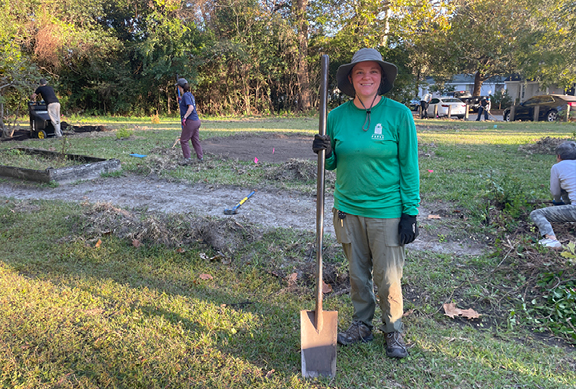
Volunteers dig into second Food Forest in West Ashley
by Lorne Chambers | Editor
The hands-on work marked an exciting milestone for the Charleston Parks Conservancy’s second public Food Forest, developed in partnership with the City of Charleston. The Ashleyville site, located along the West Ashley Bikeway, will build on the success of the Conservancy’s pilot Food Forest at Mulberry Park, which debuted last year as South Carolina’s first public edible park.
“We’ve been using some ‘best practices’ we learned from the Mulberry site,” said Sam Haab, Community Garden Manager for the Parks Conservancy.
On Friday, Oct. 24 Haab was personally getting her hands dirty, while also handing out gloves, rakes, shovels, and pointing to places on a hand-drawn rendering of the site, which showed where there would soon be blueberries, persimmons, figs, peaches, pomegranates, olives, pineapple sage, and more.
For longtime Ashleyville-Maryville residents, the project represents more than trees and compost. Janet Ansley, an avid gardener who has lived in the neighborhood for more than 30 years, was among the volunteers who turned out to help prepare the site.
“You’ve got to support your neighborhood,” Ansley said, taking a momentary break from raking. “People from the neighborhood who have never gardened before can come and enjoy it and learn about gardening. Somebody might come by here and have some fresh fruit or vegetable and never buy that at the store again.”
Another member of the community, Tyler Corsello, was vital in getting the conservancy to look at the historic Ashleyville-Maryville neighborhood for its second food forest, which was first conceived through neighborhood input sessions in 2024, when residents like Corsello voiced a desire for greater access to fresh, healthy food options close to home.
“During COVID, I got really into gardening,” said Corsello. “I stumbled upon the (Mulberry) Food Forest and thought it was a great idea. I read online that they were looking to expand the project, so I reached out. They were super, super quick to jump on it.”
According to Corsello, a lot of people in this neighborhood don’t have cars and have to cross two highways to get to the nearest grocery store. He sees three main benefits to having a food forest in the neighborhood: free food, community engagement, and education.
With support from Bank of America and the Volvo For Life Fund, the Conservancy secured funding and worked with the City to design a third-acre community green space that will feature existing mature fig trees along with more than 30 new edible trees, shrubs, and perennials.
When fully planted, the Food Forest will provide free, organic produce for neighbors to harvest, while also serving as an outdoor classroom for workshops on growing, preserving, and cooking healthy foods. The initiative expands on the Conservancy’s “Grow It Forward” program, which has distributed more than 34,000 pounds of produce to local resource centers since 2014.
Beyond providing food, the Food Forest will also deliver environmental benefits such as improved air and water quality, carbon absorption, and urban cooling. Conservancy leaders say it’s a model that’s already inspiring other communities—five municipalities have contacted them for guidance on creating similar public food spaces.
Learn more or support the project at
www.charlestonparksconservancy.org.


