
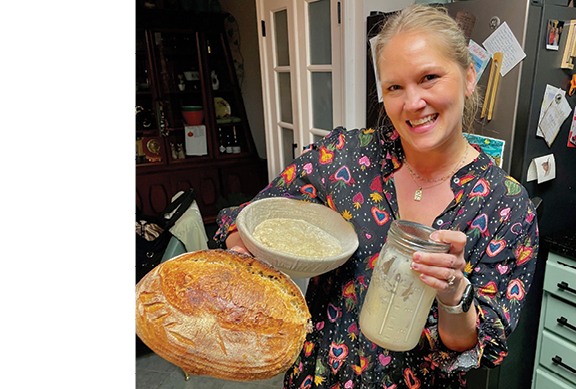
West Of’s Sales Manager takes the plunge into the wild and wonderful world of sourdough
by Lindsey Chambers | West Of Sales Manager
I pull my sourdough starter from the fridge to allow her to warm up, grow, and fall overnight. I go to sleep dreaming about my sourdough baby and the many steps ahead of me the next day, and the next, to finally make her into a loaf of bread. Tomorrow I’m working from home, so I think it’s a good day to tend to her needs and do the four required stretch & folds every 30 minutes. She’ll rest on a warm surface between each exercise, growing as my workday progresses.
Next, I’ll pre-shape, rest, split the dough into two balls, fold each ball four times, let them sit on a floured surface for one hour, then do the final shape and set them in floured bannetons in the fridge, where they will cold ferment overnight. The next morning, I will score them, and they’ll be ready to bake. Then, after 40 minutes in the oven, I will have bread… if I’ve done everything right.
I named my sourdough starter Margaux, the most pretentious spelling of the name, meaning “pearl,” something that’s soft, precious, temperamental, and worth nurturing.
A few months ago, I killed my first sourdough starter. I don’t really know what went wrong other than I didn’t have a real understanding of bread making, and admittedly, I’m not much of a baker. It had turned a putrid yellow and no longer had a pleasant smell. I asked my pastry chef neighbor if she could come over to perform CPR, but she declared it dead on arrival. I thought this was the end of my sourdough era. That I did not have what it take to even keep my starter alive, much less make it through the 48-hour fermentation process, let alone to bake day.
As fate would have it, just a couple of weeks later, I discovered Philip Lipton’s Moonrise Method Sourdough Workshop in West Ashley. It was a new year, and I was stoked to take on new experiences and challenge myself in 2026. The timing was perfect.
Seeking Professional Help
So just like a kid on their first day of 2nd grade with a new outfit and backpack, I strolled up to St Andrews Presbyterian Church on Wappoo Road for Moonrise’s January Sourdough Workshop with my new mixing bowl and still-in-the-box Sourdough Starter Kit that I got for Christmas.
Philip was warm and inviting and even cracked a few jokes right off the rip to get us all loosened up, just in time to start loosening up our dough. One of the first big lessons he taught us was “It’s good to be stressed about your starter.”
OK, so my dreams and talking in my sleep about it are a new—and very important—part of my life now as a sourdough breadmaker.
Vogue just proclaimed sourdough the “Hottest Accessory of 2026” when Taylor Swift’s dinner guests were spotted leaving with one of her signature loaves. Philip understands how an artist like Swift would also be into sourdough baking.
“It makes sense that a musician would connect on a deep level with the process, seeing as music and sourdough fermentation are both time arts,” Phillip says. “What I mean by this is music and fermentation have a clear start and finish. As bakers, we follow fermentation and must know exactly when to shape our dough just as a musician follows their timeline to the end of a song.”
The Sweet Music of Breadmaking
Philip didn’t come to sourdough bread making through the traditional route. Like Swift, Philip is a musician. His instrument of choice is the clarinet. He earned a Master of Music from Indiana University and performs as a professional clarinetist. Philip is the Principal Clarinet of the North Charleston POPS! Orchestra and the founder of the Kleztonians, which specializes in a fusion of traditional Jewish music. He’s a composer, supported by the National Endowment of the Arts to write his debut album. He is an educator as Professor of Clarinet at the College of Charleston School or the Arts. He helped build the conservatory’s chambers music program with the nonprofit MUSAID in El Salvador.
As if that wasn’t impressive enough, he’s also a certified yoga instructor and blends yoga breathing and stretching into his musical teachings. The stretching also reaches into his sourdough bread making, when he teaches the “stretch and folds” method of strengthening the gluten to his sourdough students.
So how did Philip even get into sourdough? He says that when the Covid-19 pandemic hit and we were in lockdown, his clarinet gigs dried up.
“Out of boredom and trying to figure out what to do next, I put an ad for sourdough loaves on Facebook. I immediately had a flood of messages and found myself delivering loaves as far as Summerville from James Island, which was easy to do with few cars on the road”, he says.
And Moonrise Sourdough was born. The name came to him while sitting outside by a fire with his wife one evening, while his bread was cold fermenting for the next morning’s bake.
Philip’s passion for bread began early, sparked by helping his mother bake in their West Ashley home as a child and by the diverse food cultures he encountered growing up. That early exposure sparked a curiosity about traditional, old-world breadmaking.
“I remember asking her how to make the beautiful artisan loaves I’d seen in bakeries,” Philip recalls. That interest deepened in college, when he studied abroad in Spain and fell in love with the small, neighborhood bakery culture there.
Sourdough Stress
As for my breadmaking journey. At 3 p.m. I received a last-minute invite to dinner in two-and-a-half hours. I said yes, and immediately panicked because I still had one more stretch and fold to go, the pre-shape, the rest, the folding of each ball four times, the one hour left to sit on the counter, the final shape, and placing them in their final resting place for the night. I’ve already invested hours. Could I bring my dough to the restaurant and see this through? Do I cancel dinner to tend to my sourdough baby? Do I give up the chance to have my first sourdough loaf, after already coming this far?
Remembering Philip’s wisdom, “Love is what brings it all together, the dough always needs a little love just like us,” it really was a tough decision.
I decided to roll the dice and speed through the last couple steps to make it to dinner on time. It was not a restful night of sleep. I dreamt that my loaves came out of the oven as flat as pancakes and hard as rocks. But, to my surprise, one of the loaves shaped and baked beautifully and made the most delicious chicken sandwich the next day for lunch. Armed with Philip’s sourdough knowledge, I think I have it in me to bake another loaf.
Philip comes with great advise. “Stick with it. It’s like any new skill, it takes practice. If you were to play the guitar for your friends at a party, would you leave the guitar sitting there and wait until the party starts to play for everyone? Go easy on yourself and focus on the fermentation rather than the technical aspects (folding, kneading, etc).”
Practice makes perfect. And until then, you can buy Moonrise’s signature traditional wheat sourdough loaf for $12.10 at the Sunday Brunch Farmers Market on James Island every Sunday 11am-3pm. It’s really good bread and worth standing in line for. Just get there early, he usually sells out.
Moonrise Method Sourdough Workshop offers monthly Sourdough Workshops. The next one is Saturday, Feb. 21, 4-6:30 p.m. To reserve a spot, email moonriseloaf@gmail.com. Visit www.moonrisebagel.com for more info.


