
A brief history of St. Andrew’s and Middleton High
by Donna Jacobs | Contributing Writer
Twenty-five years ago, St. Andrew’s High School (Rocks) and Middleton High School (Razorbacks) closed their doors and became West Ashley High School. The Rocks and the Razorbacks were now a cherished memory that past alumni and the Wildcats had formed.
The two former schools have quite different histories. St. Andrew’s High School was originally known as St. Andrew’s Parish (High) School. The school, located on Wappoo Road, began on the Legare property along the Ashley River in the late 1800s. The Wappoo Road location was ultimately chosen as the site for the school because this was considered the center of the Parish.
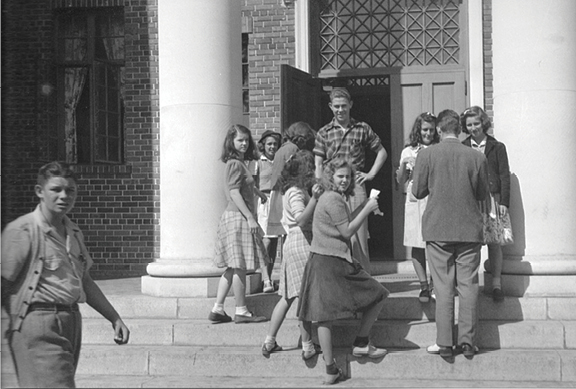
The red brick building with its “Senior Steps,” that’s so fondly remembered, was constructed in 1929 and housed grades one through seven beginning in the school year 1930-31. The evolution of this school for White students happened over time to include 12 grades.
Housing stock, suburban neighborhoods, and young families were growing on land that once produced cabbage and other vegetables, and the need for schools grew along with it. By the early 1940s, the population of the Parish had grown, thus necessitating the building of a stand-alone elementary school.
In 1944, Albemarle Elementary School on Sycamore Avenue opened its doors. The construction of St Andrew’s Elementary soon followed (1950 opening), then St. Andrew’s Junior High School (1959 opening). The Parish was booming, and this continued addition of new schools was evidence.
St. Andrew’s Parish High School educated predominantly the White students until the late 1960s. In 1967, South Carolina Act 340 created the Charleston County School District. It was during this time that the integration of the school system began to happen in Charleston County, an important and necessary step for School District 10.
In 1970, Middleton High School was the first high school-level grade to split from the centrally located St. Andrew’s Parish High School. With this came the closure of Wallace Consolidated School, which was devoted to the education of the parish’s Black students.
The change in school loyalty, combined with racial integration, was a mixture that the community needed to manage. The Rocks-Razorbacks rivalry had begun … or had it?
Team sports helped give rise to a school’s identity, spirit, and communal feeling. This was going to take a minute for the students involved with transitioning to the new Middleton High School. An article that ran in the June 27, 1970 issue of The Evening Post outlined the St. Andrew’s School District’s reorganization of the athletic staff for the upcoming school year, which would introduce the new high school, Middleton. For the 1970-71 school year, the football team would play a schedule as a combined team, choosing the name “RazorRocks”.
This would give the School District time to organize a football program at Middleton. The other sports, like basketball, would begin with their own programs at Middleton taking on “Razorbacks” as the school mascot. Thus, during the 1970-71 school year the students would be teammates during football season and rivals at basketball games. This combination even applied to the cheerleaders – combined cheering for football and rival cheering for basketball.
This is just one aspect of a large, multi-faceted, important story to tell in the history of the lineage of the Parish schools, which includes racial segregation, consolidation, integration and school mergers.
For now, the Rocks and the Razorbacks story told through the lens and direction of Tim Fennell and Neal Kinard in their upcoming documentary Rocks and Razorbacks: When Your School Goes Away will serve as a microcosm of this complexity.


