
West Ashley artist Karl Zurfluh’s Avondale mural tells a story
by Hanalei Potempa | Contributing Writer
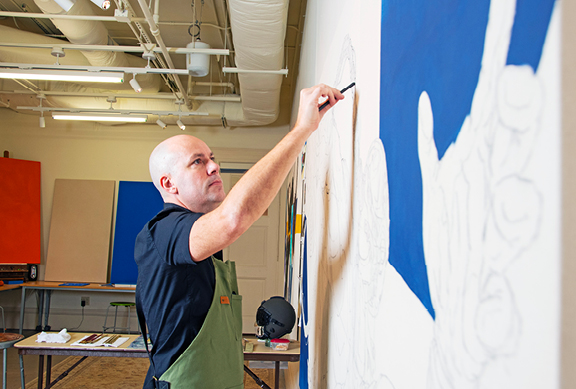
West Ashley artist Karl Zurfluh has completed a striking new mural in the Avondale Business District, a vivid addition to his ongoing “Light Pilots” collection.
Originally from Tacoma, WA, Zurfluh’s artistic journey spans the country and multiple creative disciplines, from New York to Los Angeles and now Charleston.
He began studying fine arts at Cornish College of the Arts in Seattle before transferring to Ringling College of Art and Design in Sarasota, FL to study illustration. From there, Zurfluh moved into graphic design, later earning an MFA in computer animation in New York and working in advertising and commercial art in Los Angeles.
Zurfluh’s extensive artistic portfolio is as dynamic as the work itself, and graffiti and murals have been part of his creative process since high school.
Though it wasn’t until he moved to Charleston that he began sharing paintings—a style still rooted in his early influences.
“When I moved up to Seattle after high school, I got very into hip-hop and started spray painting,” Zurfluh recalls. “That took a course on my artistic style and my influences.”
For much of his career, Zurfluh kept his different art forms separate, maintaining distinct portfolios for graphic design, illustration, computer animation, and more. But after moving to Charleston, he began to merge those creative avenues into one cohesive artistic brand.
“There were all these sort of separate portfolios with separate identities and branding,” he says. “When I finally moved to Charleston, that was the first time that artistically, I started crossing all those streams.”
Fueled by a renewed passion for painting, Zurfluh began pursuing fine art more seriously.
“I’ve been doing paintings my whole life,” he says. “I never stopped doing paintings, but I just never showed them. I never pursued them.”
Mural work—one of his earliest artistic pursuits—has now taken center stage, particularly as society grows more accepting of graffiti art.
“I think our society is finally catching up and being more accepting of it,” Zurfluh says. “And I think the art community around the United States is seeing that.”
When it came to the Avondale mural, inspiration struck late one sleepless night. Determined to amplify his upcoming exhibit, Zurfluh decided to chase the opportunity himself, reaching out to contacts, locating the building’s owner Edward Kronsberg and submitting a proposal within days.
“Within a week, I’d found him, given him a proposal, and gotten approval,” Zurfluh said. “And the following week, I was painting. It was all just me chasing it, trying to put in a little DIY elbow grease for my show that’s coming up.”
Working under a tight deadline, Zurfluh used one of his previous canvas pieces, “Positive Evolutions,” as inspiration to create the new mural, which he titled “Positive Evolutions 1.5.”
“I took that canvas painting and I basically cropped into it and redesigned part of that painting to create the mural,” Zurfluh says. “So that was a new thing for me, taking a canvas painting and using it as the blueprint for a mural, and I think it turned out pretty well.”
The original canvas is one of his favorite pieces from his body of work titled “Light Pilots” and he was especially excited to share the design with Avondale—an area that witnessed Zurfluh’s recent artistic evolution first hand.
The original canvas belongs to Zurfluh’s “Light Pilots” series, a body of work he describes as deeply personal and transformative. The Avondale mural, he said, was the perfect location to exhibit his artistic growth.
“If you look around those alleyways, you can see the evolution of my work,” Zurfluh says. “If you look at the rooftop of Gene’s — that was 2018 — you can see stylistically how much I’ve evolved and grown. And I think that was important for me to share with Avondale — and Charleston.”
With “Light Pilots,” Zurfluh explores themes of grief and healing, challenging the idea that grief must be moved past or silenced.
“The pilot represents humanity — there’s no body on the pilot. If you look at the helmet, it’s separated and there is no physical body,” Zurfluh says. “ It represents a pilot shell, which I equate to our physical shell, because I believe our consciousness navigates our bodies through this experience, thus making us all pilots, because our bodies are just a shell.”
The “light,” he added, symbolizes the positive lessons that emerge from hardship, whether external or from within.
“It’s a growing message,” he says. “Trying to better yourself and trying to be the best human you can be makes the community around you stronger.”
Zurfluh considers “Positive Evolutions 1.5” one of his strongest works, calling it “The jewel of the crown.” He hopes that viewers take the collection “Light Pilots” as an invitation to reflect on grief, resilience and the light that comes from growth.
“It’s okay to talk about grief, it’s okay to deal with your emotions and to express those in positive ways, and to try to grow as a human,” Zurfluh says.
He also expressed his deep gratitude for the Charleston community’s support of his projects.
“I’m really thankful for the community here, for their openness to have discussions, to talk about difficult things and to look at the positive side of life,” Zurfluh said. “To try to grow and support each other and as individuals.”
“Positive Evolutions 1.5” now stands as part of Avondale’s creative charm, and Zurfluh’s next chapter unfolds this month when the Gibbes Museum of Art debuts more of his “Light Pilots” collection. Zurfluh has served as an artitst in residence at the museum.
Karl Zurfluh’s “Light Pilots” will be on display from Nov. 19 through Jan. 7. An opening reception will be held Wednesday, Nov. 19 from 5-7 p.m. Gibbes Museum of Art is located at 135 Meeting St. For more information, visit www.gibbesmuseum.org/programs-events/art-sales-gallery/a-solo-exhibition-by-karl-zurfluh/.


