
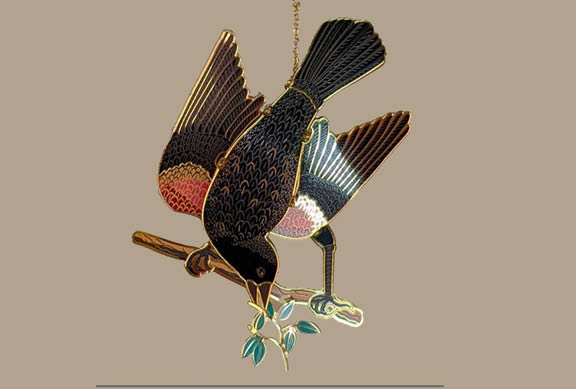
Drayton Hall’s annual ornament collection transforms an18th-century portfolio to a beloved holiday keepsake
by Hanalei Potempa | Contributing Writer
A story that began in 18th-century Europe now continues in Charleston—one watercolor, and one ornament, at a time.
In 1733, a young John Drayton returned to South Carolina with a treasure few could have imagined—a portfolio of 47 luminous bird watercolors painted by George Edwards, the man later celebrated as the father of British ornithology and known for this publication of A Natural History of Uncommon Birds (1743).
For more than two centuries, the paintings disappeared from memory as they sat quietly in an attic on East Bay Street, untouched. Only in 1969, after the death of Charlotta Drayton, were they rediscovered—a rare survival of early natural history art in North America.
Over time the portfolio scattered and sold away, but in 2009, Drayton Hall brought some home, acquiring 21 of the original works that now form the Lenhardt Collection of George Edwards Watercolors Collection.
Flights of Fancy: An Exploration of Uncommon Birds gathers these long-traveled images once more, reuniting them for the first time in 55 years and inspiring the historic site’s beloved annual ornament series.
This George Edward’s inspired ornament tradition began in 2022 through a collaboration with the Design Masters Association, known for creating custom pieces for The White House Historical Association, Mount Vernon, and the Biltmore Estate.
Kate Ludwig, Director of Retail and Admissions at Drayton Hall emphasizes the importance of historical accuracy when transforming these artworks into ornaments..
“There is a great deal of collaboration between their team, myself, and our curatorial staff to ensure every detail is accurate before anything goes into production. This careful back and forth allows us to honor the integrity of the original artwork or architectural element while creating a piece that resonates with our visitors,” says Ludwig.
The series launched with a hummingbird ornament in 2022, followed by an indigo bunting in 2023 and an owl in 2024. This year’s addition is the red-winged blackbird. Ludwig notes that visitors often help shape the collection’s direction, sharing that “we’ve already launched a poll and have a winner—though you’ll have to wait until next fall to see which bird joins the collection next.”
At the heart of Drayton Hall is the ongoing mission to preserve and creatively interpret the history of the site.
“We’re always looking for ways to develop custom pieces that are directly tied to Drayton Hall—whether that connection comes from an item in the collection, the house itself, or one of the architectural details that makes the site so special,” says Ludwig.
Beyond the Lenhardt ornaments, visitors can take home a variety of unique keepsakes such as plaster star ornaments and plaster magnolia paperweights—tributes to the ongoing preservation of the iconic plaster ceiling. Curators are also developing jewelry collections inspired by the same architectural motifs, continuing the tradition of transforming history into tangible keepsakes.
Lowcountry residents have connected deeply with this blend of art, nature, and heritage, making the ornaments a cherished keepsake and even an annual tradition for some folks.
“We see a wide range of customers who purchase the birds each year. Some collect them annually; others buy them as meaningful gifts, and a few truly go all in,” says Ludwig. “ This year, one customer purchased forty ornaments because they wanted to share them with everyone they knew.”
For Ludwig and her colleagues, these small acts of enthusiasm breathe new life into a centuries-old legacy.
“Moments like that remind us how strongly these pieces resonate with people and how special it is to see Drayton Hall’s history passed along in such a personal way,” says Ludwig.
You can purchase this year’s George Edward’s inspired ornament at the Drayton Hall Gift Shop, located at 3380 Ashley River Road or online at shop at www.draytonhall.org.


