

S.C. Supreme Court blocks North Charleston annexation, bolstering protections for Ashley River Road Historic District
from Staff Reports
A long-running fight over a small but symbolically important piece of land along Ashley River Road ended with a major win for preservation advocates and the City of Charleston.
On Wednesday, Jan. 21, the South Carolina Supreme Court invalidated the City of North Charleston’s 2017 annexation of a one-acre parcel near the Ashley River, ruling the property was not “adjacent” to North Charleston’s existing city limits as required under state annexation law.
The decision is significant not only for what it means for West Ashley along the Ashley River Road corridor—one of the Lowcountry’s most historic and scenic landscapes—but also for the legal standard it reinforces: a municipality can’t “leapfrog” over someone else’s land (or another city’s boundaries) to claim a disconnected piece of territory.
How the dispute began
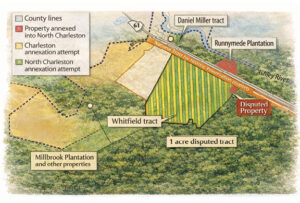
The case centers on a cluster of properties near Highway 61 and the Ashley River:
• A “narrow strip” owned by the National Trust for Historic Preservation: Since 1980, the National Trust for Historic Preservation has owned a long, 100-foot-wide strip of land running roughly 2.2 miles along the southwest side of Highway 61. Charleston annexed that strip in 2005, placing it within Charleston city limits.
• North Charleston’s 2017 annexations: In October 2017, North Charleston annexed a larger tract known as Runnymede on the northeast side of Highway 61. In December 2017, City Council adopted Ordinance No. 2017-080 to annex a separate one-acre parcel on the southwest side of Highway 61—but that acre does not touch Highway 61. It sits across the National Trust’s 100-foot strip.
In its opinion, the Supreme Court described the layout plainly: the annexation parcel sits about 100 feet from Highway 61, separated from the road—and from North Charleston’s nearest territory—by the National Trust strip, which is inside the City of Charleston.
Charleston and the National Trust challenged the annexation, arguing it violated the state statute North Charleston used (S.C. Code § 5-3-100) because the one-acre parcel was not “adjacent” to the city’s existing boundaries.
Public meetings and local pushback
Even before the case reached the Supreme Court, the annexation dispute played out in public meetings and news coverage as residents, conservation advocates, and officials weighed what was at stake along the Ashley River Road corridor.
In January 2018, Charleston City Council voted unanimously to pursue annexation of large nearby acreage in the Whitfield tract area—an action framed at the time as a defensive move amid concerns that different municipal rules could allow substantially denser development along Highway 61 if North Charleston gained control.
As the legal fight continued, preservation organizations repeatedly pointed to the Ashley River Historic District’s national significance and vulnerability. The National Trust has said the disputed annexation threatened to weaken protections and open the door to development inconsistent with the historic district and the setting around Drayton Hall.
More broadly, the Ashley River Road corridor has seen intense public engagement on planning and infrastructure decisions in recent years—including organized public comment campaigns focused on keeping changes compatible with the area’s historic character.
What the Supreme Court ruled … and why it matters
The Supreme Court’s decision did two key things:
1. It restored “standing” for Charleston and the National Trust to sue. Lower courts had tossed the case on procedural grounds, finding the plaintiffs lacked standing. The Supreme Court disagreed, holding Charleston had a sufficient stake because the annexation path ran “into and through” Charleston’s city limits, and the National Trust had standing because the ordinance description purported to annex a small piece of its land without permission.
2. It ruled the annexation itself was invalid because “adjacent” means touching in this context. North Charleston argued “adjacent” could mean merely “near.” The court rejected that, concluding that South Carolina’s annexation scheme is premised on contiguity, and because the National Trust strip sits between the acre and North Charleston, the parcel is not “adjacent.”
In practical terms: North Charleston’s one-acre annexation is void.
What happens next along Hwy 61?
Preservation groups say the ruling helps keep the Ashley River Road Historic District’s planning and conservation framework intact by preventing a jurisdictional shift that could have altered land-use outcomes along the corridor.
Separately, the National Trust has also signaled continued work on longer-term recognition and protection efforts for the district, including pursuing a stronger national designation. The Ashley River Historic District was included on the National Trust’s list of America’s 11 Most Endangered Historic Places in 2018 due to this threat. In November 2024, the National Trust submitted a letter of inquiry, with research to elevate the entire District to a National Historic Landmark. Last month, after reviewing the Trust’s inquiry, the National Park Service agreed that the District was eligible for NHL status, and the National Trust could move forward with the nomination.
For residents of West Ashley and the broader Lowcountry, the ruling is a reminder that the region’s most iconic landscapes can hinge on technical legal definitions—like whether land “touches”—and that those definitions can shape everything from zoning and infrastructure to the long-term character of the Ashley River Road corridor.


